The Property Changed but the Bigger Change Was Me
Ten years ago, I probably would have written a check, fixed the basement, and stopped there. Today, I’m borrowing to complete a broader improvement plan.
The immediate problem was straightforward: determine the cause of the water and correct it.
The options:
Should we use cash to solve only the basement problem? Should we refinance and address the basement along with an aging furnace and air conditioner? Or should we use the financing opportunity to complete a broader group of improvements and move the property to a stronger long-term rent position?
All three were reasonable choices.
The Property
The property currently rents for $1,540 per month. Before the basement issue arose, we had already identified it as a rent-reset candidate.
It was also carrying very little debt:
· Existing loan balance: approximately $18,000
· Existing monthly payment: $399
· Interest rate: 6.5%
· Estimated loan-to-value ratio: approximately 8%
The low debt was comforting, but it also meant that a considerable amount of equity was sitting unused.
Meanwhile, the property had several current or approaching needs:
· Basement water remediation
· Aging furnace and air conditioner
· Windows replacement
· Kitchen flooring
The basement required action. The HVAC system would eventually require action. The tenants had identified the windows and kitchen flooring as their priorities.
That combination led us to look beyond the immediate repair.
Three Reasonable Options
Option 1: Pay Cash and Fix the Basement
Based on similar work at another property and preliminary pricing, we estimated the basement solution at $5,000 to $12,000.
The simplest response was to pay cash, complete the basement work, and retain the existing loan.
This option would create no new debt and minimize future interest expense. It would also avoid refinancing costs and a new balloon obligation.
For an owner with sufficient cash, a strong preference for low debt, limited rent upside, or plans to sell the property within a few years, this could be the best decision.
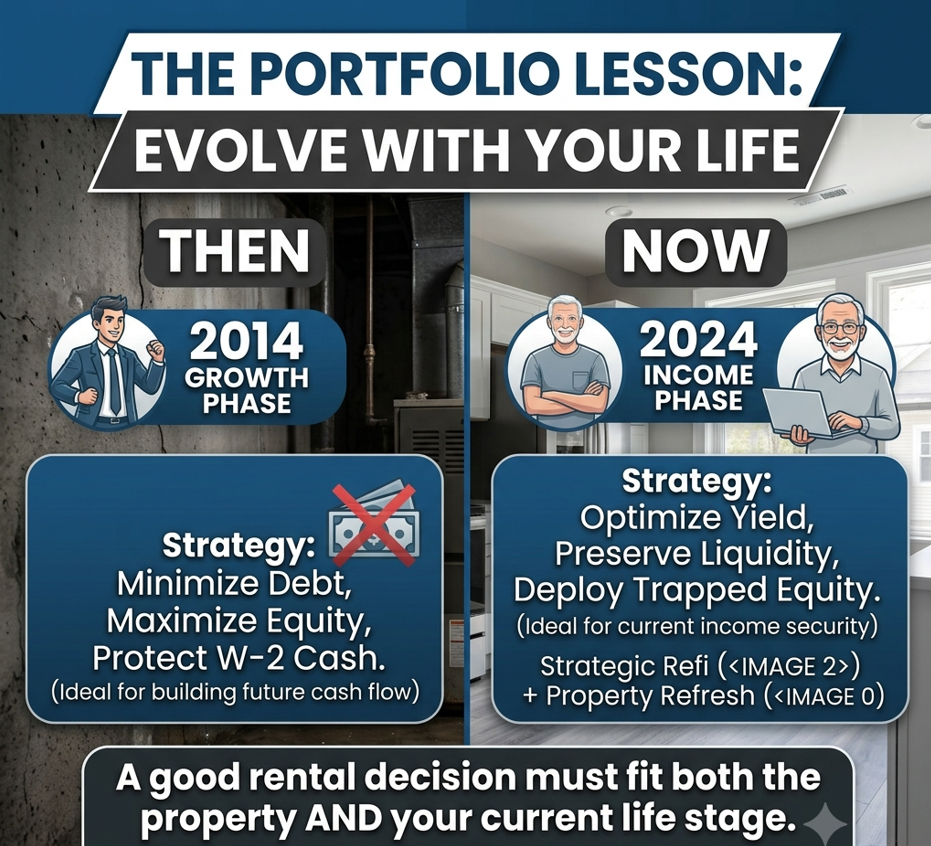
It probably would have been my decision ten years ago.
At that time, I was a high-earning W-2 employee. I did not rely on the rental properties for current income. We were still building the portfolio, our cash reserves were growing, and Theodore had not yet appreciated enough to create substantial unused equity.
My objective was to build future cash flow.
I likely would have fixed the basement, continued operating the existing HVAC until replacement became necessary, and postponed the windows and kitchen flooring.
Option 2: Refinance and Address the Major Risks
The second option was to refinance the property and use the proceeds to correct the basement problem and replace the furnace and air conditioner.
We estimated:
Basement remediation: $5,000 to $12,000
Furnace and air conditioner: $8,000 to $10,000
Total preliminary improvement cost: $13,000 to $22,000
This option would preserve cash while addressing the two largest property risks.
It could be the best fit for an owner who wants to avoid a large cash outlay and reduce the likelihood of an emergency HVAC failure but does not see enough rent potential to justify a broader improvement plan.
It is the middle path: protect the property, improve reliability, and stop short of a full repositioning.
Option 3: Refinance and Complete the Broader Plan
The third option added window replacement and kitchen flooring to the basement and HVAC work.
The windows are expected to cost approximately $4,300 installed. The flooring cost is still being finalized.
The broader plan is expected to approach $30,000 when the full scope, financing costs, and remaining work are included.
This was the option we selected.
The approved $48,000 cash-out refinance will pay off approximately $18,000 of existing debt and fund the improvements. Our plan is to complete the work without making a cash contribution from portfolio reserves, provided final project and closing costs remain within the available proceeds.
The new monthly principal-and-interest payment will be $365.41, compared with the current payment of $399.
That is what made the structure especially interesting:
Approximately $30,000 of work planned
$0 planned owner cash contribution
No reduction in current property cash flow from the scheduled loan payment
Approximately $2,400 in additional annual rent projected after the rent reset
The $2,400 is projected additional rental income—not guaranteed net cash flow. Management fees, operating expenses, final project costs, and the actual rent decision still matter.
But the financing allows us to complete substantial work without reducing the income the property produces today. The lower scheduled payment provides a small cash-flow improvement even before the rent changes.
What the AI Analysis Added
AI-assisted five- and ten-year projections helped us compare the choices.
The value was not that AI selected the “correct” option. It did not.
The analysis showed that the preferred option changed depending on what we were trying to accomplish.
Option 1 performed well when the priority was minimizing debt, financing costs, and project scope.
Option 2 made sense when the priority was preserving cash and reducing the most significant property risks.
Option 3 became more attractive when the priorities were protecting current cash flow, putting unused equity to work, completing several needed improvements together, and increasing the property’s future income.
The projections also forced us to consider the disadvantages of our preferred option.
The new loan extends the debt, increases the total interest paid, and includes a five-year balloon. Interest begins accruing on the full loan at closing, even though the bank will release the improvement funds only after receiving invoices or proof of payment.
The lower monthly payment does not mean the financing is less expensive. It means we are accepting more long-term debt and interest to preserve cash and current income.
That tradeoff works for us today. It would not work for every owner.
The Tenant Is Part of the Plan
Our current tenants have been reliable, and we would like to retain them.
They identified the windows and kitchen flooring as their priorities. We added the flooring to the plan partly because of their request and placed both items early in the work sequence:
· Replace the windows
· Install the kitchen flooring
· Complete the basement remediation
· Replace the furnace and air conditioner
The tenants know about the broader improvement plan, although we have not given them an exact future rent increase.
The rent reset was always part of the equation. The property was under-rented before we decided to borrow, so the improvements did not create the need for an increase.
Instead, the work should strengthen the rent the property can support, improve the tenants’ experience, and make a reasonable reset easier to accept.
That distinction matters.
The logic is not: We spent money, so the tenants owe us more.
The logic is: The property was already below its supported rent, and the capital plan should leave it in better condition when the rent is reset.
Why Option 3 Fits Me Today
I am now retired, and the rental portfolio serves as an income stream.
Current cash flow and available cash matter more to me than minimizing debt twenty years from now. I am willing to carry long-term debt when it allows the portfolio to maintain current income, preserve flexibility, and improve future earning power.
Theodore’s very low leverage also matters. We are not borrowing against a highly leveraged property and hoping that rent growth rescues the decision. We are putting a portion of accumulated equity to work.
The capital investment should increase the property’s value, but maximizing equity is not our primary objective. We already have substantial equity across the portfolio.
The priority is turning part of that equity into stronger property performance and retirement income without using cash we may need elsewhere.
The Larger Lesson
Rental-property decisions are often presented as though there is one financially correct answer.
Pay cash or borrow.
Reduce debt or invest.
Repair only what is broken or complete the larger improvement plan.
But the property’s numbers do not determine the answer by themselves.
The owner’s income needs, tax position, debt tolerance, liquidity, time horizon, and stage of life also matter.
Ten years ago, Option 1 likely would have been right for me.
Today, Option 3 is the better fit.
That is one of the central ideas behind Small Rental Property Portfolio Optimization: evaluate each property as part of an operating portfolio, and make sure the portfolio evolves with the owner.
A good rental-property decision must fit both the property and the person who owns it.
As the owner’s life changes, the job of the portfolio should change with it.
A Rental Property Modernization With $0 Cash In, $30K of capital improvements and increased cash flow
A basement water problem forced us to decide whether we were making a repair—or repositioning an asset.
The property is a long-held single-family rental currently producing $1,480 per month. It has substantial equity, a small mortgage balance, and several capital needs that we knew would eventually have to be addressed.
The immediate issue was water entering the basement. The simplest response would have been to diagnose the problem, pay for the necessary repair from reserves, and move on.
That would have solved the immediate problem. But it would not have addressed the aging furnace and air conditioner, inefficient windows, worn kitchen flooring, or a rent level that was already due for review.
The water problem created a broader decision point.
Three Reasonable Options
We considered three basic approaches.
Option 1: Repair the basement with cash
The first option was to use reserves to address only the water problem.
This would have been the least complicated approach. It would avoid new debt, minimize the project scope, and resolve the most urgent risk.
However, it would leave the other capital needs in place. We could easily find ourselves making another large withdrawal for the HVAC system within the next few years—and still have a property with older windows, worn flooring, and limited improvement in its market position.
This was the lowest-cost decision today, but not necessarily the best operating strategy over the next several years.
Option 2: Finance the basement and HVAC
The second option was to refinance the property and use the proceeds for the basement work and HVAC replacement.
This would address the two most important property risks while preserving our cash reserves. It would also reduce the likelihood of an emergency furnace or air-conditioning replacement later.
The limitation was that the property would remain only partially updated. The mechanical and water-management systems would improve, but the resident-facing condition of the property would change very little.
That raised an important question: If we were already going through the financing process, was a partial modernization the best use of the available equity?
Option 3: Finance a broader modernization
The third option was to refinance the property and complete a coordinated improvement plan:
Diagnose and correct the basement water problem
Replace the furnace and air conditioner
Install new windows
Replace the kitchen flooring
This was the most comprehensive option. It also required the most planning, contractor coordination, and cost control.
But it offered something the first two options did not: the ability to address several known needs at one time and reposition the property for its next operating cycle.
That became our preferred direction.
The Tenant’s Perspective Matters
Before finalizing the plan, our property manager discussed the improvements with the tenant.
The tenant specifically requested the windows and kitchen flooring. They would like to remain in the property after the work is completed and understand that the rent will increase at the next renewal. We have not communicated a specific increase.
This is important for two reasons.
First, the improvements address conditions that matter to the current tenant. The project is not based entirely on our assumptions about what a future renter might value.
Second, the tenant’s interest in remaining creates the possibility of improving the property without a vacancy, lease-up fee, or turnover expense. There is no guarantee that the tenant will renew, but their stated preference reduces one of the major uncertainties in the plan.
We do not need an immediate rent increase to support the financing decision. The current rent continues until the next renewal, when the completed improvements and updated market evidence can be evaluated together.
The Financing Structure
The approved cash-out refinance is $48,000.
The existing loan payoff is approximately $18,000. After the payoff, loan fee, appraisal, and other closing costs, approximately $28,000 will be available for the property improvements.
The financing requires no owner cash contribution. The entire planned project will be funded from the property’s existing equity.
The new loan has:
A 6.75% fixed interest rate
A 20-year amortization schedule
A five-year balloon
Principal and interest of approximately $365 per month
A declining prepayment penalty during the first three years
The existing mortgage payment is approximately $399 per month. The refinance therefore releases approximately $28,000 for improvements while reducing the required monthly principal-and-interest payment by about $34.
Without any rent increase, property cash flow should remain approximately unchanged or improve slightly because of the lower mortgage payment. The payment difference represents approximately $408 per year before considering any changes in operating expenses.
The future rent increase will improve the economics, but it is not required to prevent an immediate reduction in cash flow.
The Lower Payment Needs Context
The payment reduction sounds unusually favorable, but it is not free money.
The existing loan had a relatively short remaining life. The refinance extends the repayment schedule and converts a loan that was approaching payoff into a new obligation amortized over 20 years.
The five-year balloon means the remaining balance must be resolved at the end of year five—well before the 20-year amortization schedule is complete. The balance may need to be paid from available funds, refinanced, or renewed with the lender.
The worst-case financing outcome is having to pay the remaining balance at the five-year maturity instead of allowing the loan to continue amortizing over the full 20 years.
Given the property’s equity position and the portfolio’s low leverage, we consider that risk manageable. But it is still a real future liquidity obligation that should remain visible.
We are exchanging faster debt repayment for current liquidity and capital investment in the property.
That is the real financing decision.
Matching the Financing to the Work
Current project estimates include:
Basement mitigation: approximately $5,000 to $12,000
Furnace and air conditioner: approximately $8,000 to $10,000
Windows: approximately $4,300 installed
Kitchen flooring: cost still to be finalized
Based on those ranges, the available proceeds appear capable of funding most or all of the planned work. The final result will depend heavily on the basement diagnosis and the flooring scope.
The bank will hold the cash-out proceeds in escrow and reimburse documented property-improvement expenses. That provides spending discipline, but it does not replace our responsibility to diagnose the problem correctly, compare contractor scopes, and control costs.
A $28,000 funding source does not automatically justify a $28,000 project.
Each improvement still has to earn its place in the plan.
This Is Not Just a Rent-Increase Project
It would be easy to evaluate the entire decision by asking whether the improvements will produce enough additional rent to repay the loan.
That calculation matters, but it is incomplete.
Basement water mitigation and HVAC replacement are primarily risk-management and asset-preservation expenses. They may not produce a dollar-for-dollar rent increase, but ignoring them can create much larger future costs.
The windows and flooring affect energy efficiency, appearance, resident experience, retention, and future marketability. In this case, the current tenant requested both improvements and has expressed an interest in staying.
The property was also a rent-reset candidate before the capital plan began. The modernization creates a better foundation for a rent increase at the next renewal, but the amount will not be determined until we can consider:
The final improvement scope
The property’s condition after completion
Current market-rent evidence
The tenant relationship
The value of avoiding turnover
The project should improve the property’s future income position. It does not need an aggressive rent assumption to make the initial financing work.
Why We Chose the Broader Plan
Our portfolio has low overall leverage and meaningful property equity. At this stage, allowing all of that equity to remain idle while repeatedly using cash reserves for major repairs is not necessarily the most efficient strategy.
The refinance allows us to:
Complete the improvements with $0 of owner cash invested
Preserve cash reserves
Maintain or slightly improve current cash flow before a rent increase
Address several known capital needs together
Reduce the risk of an emergency HVAC replacement
Complete improvements requested by the current tenant
Improve the likelihood of retaining the tenant
Support a future rent repositioning
Convert a portion of dormant equity into productive property improvements
The five-year balloon remains the primary financing risk. The principal safeguards are the property’s substantial equity, the portfolio’s low leverage, and the ability to plan for the maturity well in advance.
The Bigger Change
Ten years ago, I probably would have written a check, fixed the basement, and stopped there.
At that time, our priorities were different. We were still building the portfolio, maintaining larger cash reserves, and focusing more heavily on long-term equity growth than current cash-flow optimization.
Today, the portfolio is mature, leverage is low, and the objective has shifted. We are looking more carefully at how existing equity can improve property condition, cash flow, tenant retention, and long-term operating flexibility.
That does not mean every repair should become a major renovation. It means a significant repair can be a useful trigger to step back and evaluate the entire asset.
Sometimes the right answer is to fix the immediate problem and move on.
Other times, the repair exposes a broader opportunity.
In this case, the property changed—but the bigger change was how we made the decision.
